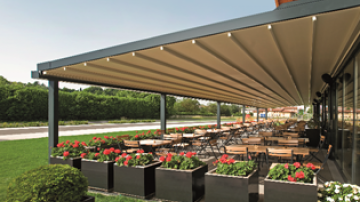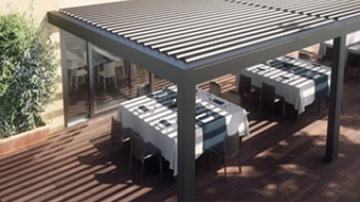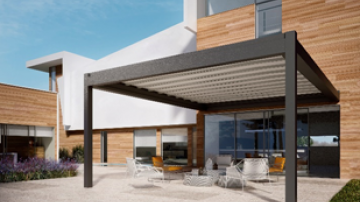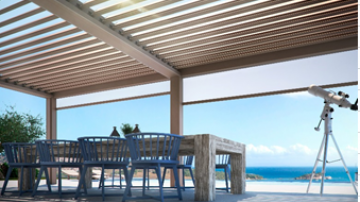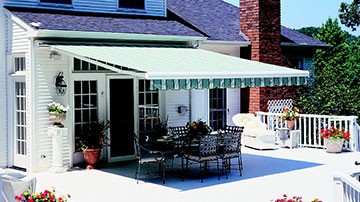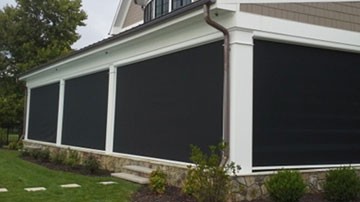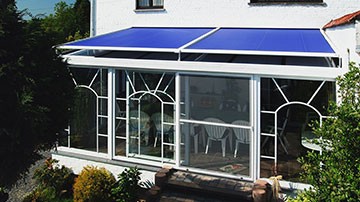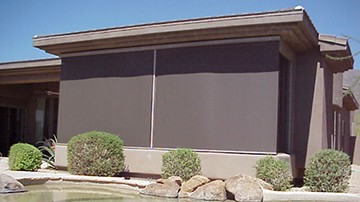
What will Sunair Solar screens do for me?
Solar screens can significantly reduce indoor room temperature, often by as much as 20 degrees during summer months. This reduces air conditioning costs. In winter, unlike window tinting, solar screens can be raised, allowing the winter sun's warmth to enter and warm the room.
Solar screens, whether installed inside the room or outside, will reduce sun's glare, while preserving the view. Solar shades also cut down on interior fading of floors, carpets, and furniture caused by UV sunlight.
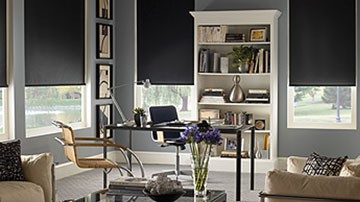
Solar screens give you daytime privacy in your home or office. Sunair offers black out type fabrics that completely block all light. These fabrics are ideal for media rooms and where privacy is important.
Many screen fabrics accept printing. Screens can serve double duty; first as a window treatment, and secondly as an advertising medium for commercial spaces in offices and retail businesses.
Choosing the perfect screen system
Sunair solar screens are available for either interior or exterior use. They can be manually operated or motorized. Each screen is custom designed for your specific application. Frame color, fabric selection, size and opperation method are all up to you as a customer.
Reviewing the considerations below will help you in selecting the best custom screen system for you. Better yet, plan on meeting with a Sunair Representative to discuss and select the best screen system. Go to the "find a dealer" tab at the top of the page.
Placement:
Sunair Solar screens can be installed either on the outside of the window glass, or on the inside of the window glass, or where no window glass existed before.
Wherever placed, solar screens offer substantial benefit to the owner, often paying for themselves in energy savings and by preventing UV sunlight damage to expensive interiors.
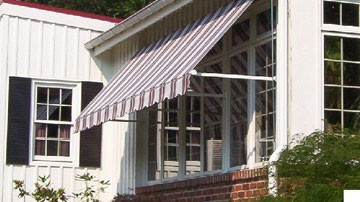
Solar screens can be installed either on the exterior or interior of the windows. With exterior solar screens installations, the fabric blocks the sun's heat before it enters the home through the glass. This stops the window glass from getting hot and becoming a summer heat radiator. Exterior installation cuts room heat the most.
Sometimes it is not feasible to install a screen on the exterior. In that case, interior screens offer a good alternative. Interior screens don't need to survive rain and are priced below exterior screens.
Fabric & Frame selection considerations
Since exterior solar shades can effectively block up to 90% of solar heat rays before they heat up the glass. You could realize a reduction in air-conditioning costs by as much as 25% - 40%.
So if energy saving and UV protection is most important, then a more closed or tighter weave is better suited. If view is important, a more open weave is a consideration. Fabrics are available from a 1% to 14%
openness factor. Fabric samples are always available for evaluation through a Sunair representative.
Once the right openness factor is determined, fabric color and pattern can be chosen.
Darker fabrics are easier to see through, to the outside, maximizing the view. Lighter colored fabrics allow visible light to enter but slightly reduce the view. Light fabric is appropriate when eliminating exterior distractions is desired.
How the screen can be operated:
Small Exterior or interior screens can be motorized or operated manually. Motorization is recommended for larger screen systems. They can be activated by a wall mounted or a hand held transmitter, or automatically by sunlight, temperature or home automation systems like
Somfy's Tahoma system.